Tuesday, January 05, 2010
CALAMITY JANE (1953)

Monday, December 21, 2009
TRAMP, TRAMP, TRAMP
Tramp, Tramp, Tramp
(1926)
A film review by Dan Navarro
Copyright 2009 Dan Navarro
Harry Langdon was a supernova. As far as silent cinema is concerned, he was – this is the dictionary definiton – “an extremely bright, short-lived object that emits vast amounts of energy.”
Short-lived is right. Over the years, film researchers have remarked on the brilliance of this comic who came along and almost instantly challenged the greats of film comedy – Chaplin, Keaton, and Lloyd – and then quickly disappeared. Film historian Kevin Brownlow called Langdon “the fourth genius of screen comedy.” He was that, but for a very short period of time.
It’s a “thrill” moment that would do Harold Lloyd proud. Harry tries to escape his predicament by dismantling the fence with a hammer, but the darned thing falls apart and Harry rides it like a sled, down the hill, hundreds of feet down… and it lands right on the racing path, in front of the other contestants.
The racers rendezvous in
Tramp, Tramp, Tramp’s most spectacular scene comes after the racers have crossed what an intertitle calls “the great American desert.” A cyclone hits
Then, seeing that the cyclone is still wreaking havoc, Harry starts throwing bricks at it. That’s right, bricks. He is thinking as a child would; but lo and behold, the cyclone responds by moving away from town and dissipating into the desert.
An intertitle reads: “David slew Goliath; Daniel tamed the lions; Joshua stopped the sun; and Harry made a cyclone take the air.”
At the finish line, the world’s champion walker, Nick Kargas (Tom Murray) appears to be on his way to victory… but this time, the perpetually late Harry puts on a determined sprint, passes him up, and finishes first. He wins not only the prize money, but also Betty’s hand in marriage. And that’s love.
Saturday, September 12, 2009
MY BEST GIRL (1927)

My Best Girl
(1927)
A Film Review by Dan Navarro
Copyright 2009 Dan Navarro
If you’ve heard of the Mary Pickford legend and wondered what all the fuss was about, look no further than My Best Girl (1927), Miss Pickford’s last silent film and, arguably, her best film ever.
Mary Pickford appeared in almost 250 movies and produced 30, besides several uncredited stints as writer and director. By 1920, the year she helped establish United Artists, she was the most popular female movie star in the world. In 1927, she became one of the founders of the
It’s ironic that this Very Big Star – probably the biggest of them all – was physically tiny, standing just a shade over five feet tall.
In the wonderfully warm romantic comedy My Best Girl, Miss Pickford is Maggie Johnson, a stock room girl employed at Merrill’s Department Store. There’s a clever early scene where Maggie is asked to bring some kitchen pots from the stock room, and finds she can’t carry all of them; so she wears one of them as a shoe and brings it out that way.
Maggie falls for Joe Grant (Charles “Buddy”
What Maggie doesn’t know is that Joe Grant is really Joe Merrill, the son of the store’s owner, working incognito to learn the business from the ground up. Young Joe is “engaged to be engaged” to an upper-crust girl named Millicent (Avonne Taylor), but she doesn’t seem to light Joe’s fire the way Maggie does. The two co-workers eat lunch together, sometimes sitting in a large crate in the stock room, and we can feel their love for each other growing.
There’s a charming scene where Maggie is riding in the open bed of a truck and Joe chases after her, running pell-mell down the street, trying to keep up with the moving truck. Director Sam Taylor and cinematographer Charles Rosher keep things lively with a long tracking shot that follows Joe on his run, with Maggie and the truck bed framed in the foreground. When Joe finally catches the truck, he climbs aboard and, thoroughly smitten, builds a “throne” for Maggie out of the crates and barrels on board. He even fashions an ersatz tiara for her to wear. It’s as if Rogers and Miss Pickford invented meet-cute.
Eventually, after a comic subterfuge that lands Joe and Maggie at the Merrill mansion, the truth comes out when Mr. and Mrs. Merrill return home unexpectedly. The terrified Maggie jumps into hiding under the dining room table, but to her surprise, Joe remains standing to greet the Merrills. Hearing their conversation, Maggie finally gets the picture: She’s been romancing the store owner’s son!
Friday, June 26, 2009
TRUE HEART SUSIE (1919)

True Heart Susie
(1919)
A film review by Dan Navarro
Copyright 2009 Dan Navarro
There is a story – perhaps apocryphal, perhaps not – about the 1987 film The Whales of August , starring the graceful, willowy Lillian Gish. She was then 94 years of age, appearing in her final movie after a remarkable 75-year film career. Lillian co-starred with the 81-year-old Bette Davis, playing her sister.
This may be the shot that got Bette Davis so worked up.
Monday, February 02, 2009

SILENT MOVIE (1976)
a film review by Dan Navarro
Copyright 2009 Dan Navarro
Mel Brooks’ Silent Movie (1976), the first silent picture to be made in 40 years, strives to blend the director’s manic sense of humor with silent film conventions. Surprisingly, they make a good fit. Brooks’ comic repertoire doesn’t begin and end with witty double-entendres; here, he proves himself a master of physical comedy, too.
Brooks (who also co-wrote and directed) plays Mel Funn, a former film director who’s hit the skids, by way of the bottle. Now sober and seeking a comeback, he teams with his buddies, Marty Eggs (Marty Feldman) and Dom Bell (Dom DeLuise), to try to sell Big Pictures Studio (“If it’s a big picture, it was made here”) on the idea of making the first silent movie in 40 years.
The Studio Chief – er, make that the current Studio Chief (in Brooks’ universe, everything echoes the turmoil of real life) – played by Sid Caesar, thinks it’s insane to try to make money these days (“these days” meaning 1976) with a silent picture… unless the intrepid trio can talk some really big movie stars into appearing in it.
So off they go, in search of stars. Some of Hollywood’s big names do appear in this film, as themselves, and Funn and his pals nab all of them – Paul Newman, Liza Minnelli, James Caan, Anne Bancroft, Burt Reynolds – and they begin production of the picture.
But trouble lurks around the corner. Big Pictures Studio is on the verge of bankruptcy, and is a take-over target of Engulf and Devour, a ruthless conglomerate. (Brooks has stated, publicly, that any resemblance to Gulf & Western, which had recently swallowed up Paramount Pictures, is purely coincidental.) The only thing that can save Big Pictures is a major hit, and that’s just what Funn & Co. aims to deliver… unless Engulf and Devour can stop them.
That’s where E. & D.’s weasely CEO (Harold Gould) steps in and plots sabotage. Knowing that Funn’s two big weaknesses are women and liquor, he hires a “bundle of lust” – one Vilma Kaplan (Bernadette Peters) – to seduce Funn and drive him back to drink.
Silent Movie captures the spirit of the silent era amazingly well, for a film made in 1976. The opening scene shows the trio of Funn, Eggs, and Bell driving down a sunny, palm-lined Southern California street, and we don’t hear a single sound. I’ll admit that I suspected something must have gone wrong in the projection booth, because I was watching a motion picture, but hearing no sound, not even music. Brooks got me good, with that one.
We don’t hear any sound until their convertible coupe passes a giant billboard… and then the camera lingers on that billboard, to show us: “20th Century-Fox”… and the music begins, followed by the opening credits.
In 1948 James Agee wrote an essay, “Comedy’s Greatest Era,” extolling the virtues of silent era comedies when compared to the limp humor of talkies of the current period. Agee described the four main grades of a laugh: the titter, the yowl, the bellylaugh and the boffo.
An ideally good gag, wrote Agee, “would bring the victim up this ladder of laughs by cruelly controlled degrees to the top rung, and would then proceed to wobble, shake, wave and brandish the ladder until he groaned for mercy….”
Mel Brooks may have read that essay, for in Silent Movie he builds on his gags at every opportunity. In one scene, for example, Eggs (Feldman) is trying to board an elevator, but the door snaps shut just before he can get into it. He pushes the button again. Another elevator door opens and Eggs is ready to run – no, sprint – to it before it closes. But inside the elevator are dozens of doctors and nurses, filing out. Eggs must wait for them. He waits for what seems an eternity, but they keep coming. And coming. Nearly one hundred people, all emptying out of this one elevator. Finally only one person is left: a gigantic nurse with a malevolent glare. Eggs tries to sidestep her, but she’s too quick for him. Face to face, they continue to dance, her glare darkening all the time. Finally she moves away and the elevator door closes, leaving Eggs without a ride. Again.
That scene is a nice spin on a turn in a Harold Lloyd comedy, Girl Shy (1924), in which Harold is trying to board a trolley car but is shoved aside by hundreds of men who materialize out of seemingly nowhere. Later in Silent Movie, Brooks appropriates a gag of Charlie Chaplin’s, from Chaplin’s 1916 short, One A.M., when he does battle with a recalcitrant Murphy bed. (In a shabby edifice known, naturally, as the Hotel Sleez.)
Each of the guest stars gets a generous share of screen time, but the most sparkling is Anne Bancroft (Mrs. Mel Brooks in real life). She does a table-top dance in a night club, tangos with all three principals… and guts it out though she’s taking quite a beating. One moment, Funn is dancing with her and, when they dip, he bangs her head on a table. Later, she is being carried off stage – horizontally – by the three funnymen, who “accidentally” ram her head into a wall.
Vilma, the Bernadette Peters character, converts from femme fatale to a loving partner for Mel Funn. With Engulf and Devour now out of the way, the trio follow through and complete their movie. The night of the Sneak Preview, however, it is learned that the film has been stolen – and it’s the only copy!
Cue up some more jokes from Brooks & Co., enlivened by an encounter with a vicious Coke machine. That’s right, a Coke machine! This gag defies description; it must be seen to be believed. But with Mel Brooks at his manic best, the whole crazy cavalcade delivers some of the heartiest laughs since the real silent era ended.
Silent Movie was released to the public on DVD by Twentieth Century-Fox Video, making this consistently funny grab bag of comedy routines available for the first time.
Tuesday, November 18, 2008
FIRST A GIRL (1935)

First a Girl (1935)
A film review by Dan Navarro
Copyright Dan Navarro 2008
By now, it is probably not possible to review the sparkling Jessie Matthews musical First a Girl (1935) without referencing Blake Edwards’ 1982 smash hit Victor/Victoria, since they were both based on the same story (by Reinhold Schünzel). The Edwards film became so popular, it threatened to erase memory of Miss Matthews’ 1935 tour-de-force as well as the original film of the story, Germany’s Viktor und Viktoria (1933). Ironically, a modern viewing of the Matthews vehicle actually wins new respect for Miss Matthews' performance.
For one thing, First a Girl makes no mention of homosexuality. While the Edwards film is fueled by gay jokes, the Matthews version shows us that the subject of female impersonation is perfectly legitimate outside the lavender world.
Miss Matthews, who had her breakthrough role in the spectacular British musical Evergreen (1934), is here serviced by the two gents who helped to secure her star persona in that film: director Victor Seville and cinematographer Glen MacWilliams.
In First a Girl, Jessie is Elizabeth, a girl with a good singing voice and dancing talent who yearns for a show business career, but keeps getting turned down at auditions. Frustrated, she breaks down and cries one rainy afternoon at a coffee shop in a seedy London neighborhood. There, she is comforted by Victor (Sonnie Hale), an aspiring Shakespearean actor (read: ham) who pays the bills by doing a drag act on stage.
As it happens, Victor has caught a cold in the rain, and he’s lost his voice. So, he convinces Elizabeth that she could replace him in the act, with himself as her "manager," and no one need be the wiser.
Elizabeth, desperate for work and a place to stay, agrees to spell Victor in his act for one night only. She becomes “Victoria,” a girl pretending to be a man pretending to be a girl – on stage.
Her act gets off to a rocky start due to stage fright, but eventually she belts out her song with confidence, and wins over the raucous audience. All manner of things go wrong in the wings, though, and soon a flock of geese are swarming the stage; someone knocks over a vat of liquid paste that coats the performing area, and Elizabeth (as Victoria) slips and falls – a neat pratfall that is shown in one take, meaning it was really Jessie Matthews who took the tumble and not some anonymous stunt woman. The audience roars its approval, thinking it’s all part of the act.
When, at the end of the act, Victoria removes her wig and reveals the short haircut that marks her as a “man,” the audience is stunned for a moment… and then, they go wild again, applauding the performer who had them so badly fooled.
A certain Mr. McLintock, a high-class impresario who’s slumming in hopes of finding a good act for his upper-crust audiences, happens to catch “Victoria’s” act. He visits her and her “manager” back stage, and offers them a contract. Elizabeth, it seems, is on her way to fame and fortune – just as long as she continues pretending she is a man pretending to be a woman.
Fame and fortune does come her way, and Victor’s too. Together they tour the continent, wowing audiences everywhere they go. At a ritzy stop on the French Riviera, they encounter the glamorous Princess Mironoff (Anna Lee) and her wealthy fiancé Robert (Griffith Jones). Robert is much taken by Victoria when he sees her on stage, much to his fiancée’s amusement. She knows that “Victoria” is really a “man," but Robert does not… until the end of the act, when “Victoria” takes off her wig and exposes the impersonation.
But the deception ends one sunny afternoon in the waters of the Mediterranean, when Elizabeth goes for an ocean swim. It seems Robert is out for a swim that day too. When she encounters trouble and begins to drown, Robert rescues her and carries her to shore. There, as he deposits her unconscious body on the sand, he cannot help but notice her swimsuit and the feminine curves it displays. Now the secret is out.
Following this exposé, she returns to the club to perform her act as usual. And it is one of the strengths of First a Girl that here, when Elizabeth’s fear of her future is so severe, she delivers the film’s most glorious number: “Everything’s in Rhythm With my Heart,” a beautiful song (by the team of Maurice Sigler, Al Goodhart and Al Hoffman) that should have become a popular standard and might have, had it been performed in an American musical of that era. The song is followed by an elaborate dance routine involving dozens of chorus girls, highlighted by a brilliant solo turn by Jessie Matthews, the “Dancing Divinity” of English cinema.
Now that the cat’s out of the bag, Robert proposes to Elizabeth, she accepts, and together they set out to motor back to England. At a border stop, they are asked to show their passports. When the official sees her passport, he exclaims: “But this passport is for a MAN!” To which the beaming Elizabeth replies, “Yes, but first a girl!” And they drive off.
Wednesday, March 05, 2008
THE FALLING (2007)

The Falling
(2007)
a film review by Dan Navarro
copyright Dan Navarro 2008
For years now, movie fans have been exposed to allegorical films about the battle between the forces of God and the forces of evil. The devil always gets the best lines, whether played by Robert DeNiro, Al Pacino, or Tilda Swinton. A new independent film, The Falling (2007), by first-time director Nicholas Gyeney, continues that tradition.
When the devil (Michael Ayden) confronts the hero, Grayson Reed, in The Falling, he snarls:
“Do you know what God is? He preaches love, faith, and prosperity to his people. But that’s not what he is. He’s a selfish child who wants more. I want to make things the way they should be, but I need your help. Help me to take what is rightfully mine, and I promise you, you can change the world. He’s a tyrant, Grayson. He’s kept people blinded for so long. Help me free people.”
Those words could have been taken from the Gospel according to St. Matthew (4:1-11), in the passage where the devil tries to tempt Jesus in the desert. It is chilling to imagine that the prince of darkness could be so persuasive, though we know he probably does tempt someone in similar fashion, every day.
In Gyeney’s film – which he also wrote, produced, shot, and edited – Grayson turns down Lucifer’s enticements, just as Jesus did. Grayson, played by George Clooney lookalike Scott Gabelein, is a Seattle cop who has no connection to Satan until “The Five” – a group of Archangels – come down from Heaven in search of a warrior to stop the forces of evil.
Gyeney and his crew of actors and technicians – including his mother and his sister – shot The Falling in and around the
Visually, the film is gorgeous. Shots of the countryside flora, especially, are a treat for the eyes, captured in lush greens and yellows, probably in the
Amid all this beauty, we find a world that is “in chaos,” to quote from a speech given by a spiritual leader in the first reel. Soon, we meet The Five, sent by a Higher Power to locate a human capable of standing up to the devil himself. Of course, Grayson has no idea what he’s in for. When he first meets their leader, the Archangel Michael (Rory Colin Fretland), he suspects the guy is wacko.
Grayson lives comfortably with his kid sister in the tidy home left to them by their parents, does his job by day, and relaxes by night. He doesn’t go to church, though the local parish priest (Donovan Marley) tries to coax him and his sister Kristy (Tellier Killaby) to rejoin the congregation.
The entreaties of their religious community go for naught, until the day Grayson realizes The Five are real, and their mission is to enlist him as a warrior for the Lord. This story could have been spun off from one of Frank Peretti’s apocalyptic novels, and the fact that Peretti was raised in the
You may read reviews of The Falling that criticize some of the acting as “amateurish.” The fact that almost everyone in the cast is appearing in their first film may contribute to that view, but I found both the villain and the hero thoroughly compelling. Gabelein and Ayden put real intensity into their roles, and although I tried to catch them “acting,” I couldn’t.
There is some bloodshed in this film, but the part that I found particularly disturbing has nothing to do with physical violence, but rather the spiritual kind. In the creepiest scene, the devil tries to seduce Kristy – who knows nothing about his real identity – and actually gets to first base. Were it not for her brother’s timely intervention, Satan may have hit one out of the park.
Undoubtedly, The Falling will play better before an audience of true believers than before agnostics. Hopefully, it will reach those who are aware of the dangers posed by a secularist view of our earthly home… and open the eyes of those who aren’t.
Thursday, January 04, 2007
SULLIVAN'S TRAVELS (1941)

SULLIVAN'S TRAVELS (1941)
A film review by Dan Navarro
Copyright Dan Navarro 2007
Writer-director Preston Sturges' Sullivan's Travels (1941), a wicked satire of Hollywood, is a masterpiece, one of the best films ever made.
The first time I saw this pinnacle of Sturges' estimable career was at an "aud call" when I was in grammar school. The teachers herded us kids into the auditorium to watch a 16mm print of it and, they hoped, get us out of their hair for an hour and a half. I was only about 6 years old, but I believe Sullivan's Travels is the first film that ever made me cry tears of joy. It's been more than half a century, but my eyes still well up when I watch it, a sign that either the film is effective or I'm an easy mark. I prefer to believe it's the former.
The plot tells of John L. "Sully" Sullivan, a Hollywood director who is a big success at turning out comedies, but then gets it into his head that he should direct a "serious" film with social significance, all about tragedy, hopelessness, and suffering. To prepare himself for this bleak scenario, he decides to go on the road dressed as a bum, with only ten cents in his pocket, to learn what it's like to be poor and hungry. Be careful what you wish for. Before Sullivan's travels come to an end, he will have visited the darkest corner of the deepest pit of the human condition.
This being a Preston Sturges picture, of course there's a happy ending. But he puts the hero through hell before that happens. There's also a romance of sorts, pairing Sullivan (Joel McRea) with a young woman we know only as The Girl (Veronica Lake). I say "of sorts" because there is no love scene per se, no kissing, not even any fond hugging. The closest they ever get physically is one evening when the two ersatz hobos (The Girl has joined him in his masquerade) stop to admire the moon... and put their arms around each other, lightly. Less is more. I think the love between them seems stronger than if they were pawing each other every few minutes.
Preston Sturges began his Hollywood career as a screenwriter (Never Say Die [1939], Remember the Night [1940]), but soon prevailed on the studio brass to put him on as a director, because he was frustrated at the way directors were reshaping his words. His first film as both writer and director, The Great McGinty (1940), was a hit, and won him an Oscar for Best Original Screenplay. Sturges was on his way.
There's an early scene in Sullivan's Travels that deftly shows off Sturges' skill with wordplay. McRea, Robert Warwick, and Porter Hall are having a vigorous debate over the wisdom of embarking on Sullivan's new, change-of-pace film. The rapid-fire dialogue is intoxicating to listen to, because it seems the actors never take a breath. As each line ends, a new one begins, as if we are watching a relay race with words instead of batons. That's not all: The entire scene, from beginning to end, is shot in one continuous take, with no cuts. The camera moves as necessary, to follow the actors, but essentially it is all a single shot. And Sturges manages to bring the scene in at four minutes flat. I have no idea how he did it, or how many retakes were needed to achieve this precision. But the effect is mesmerizing.
Sturges gives us many great scenes in Sullivan's Travels, but there is one that really put a lump in my throat. Sully has been imprisoned in a Deep South chain gang presided over by a ruthless warden (the great Alan Bridge). The warden won't brook Sully's independent attitude and resolves to crush his spirit by locking him in "the sweat box," a sadistic, one-man windowless cell where the hapless prisoner is forced to stand for hours, alone.
The prison trusty, played by Sturges regular Jimmy Conlin, visits the sweat box periodically and gives water to the dehydrated prisoner, and also gives him words of encouragement. Finally, at night, the trusty is allowed to open the sweat box and release Sullivan from this torture device. He unlocks the door, and the exhausted Sullivan collapses into his arms. The camera remains still for several seconds while the trusty cradles him gently. I don't know if Sturges intended this, but the shot reminded me of a Renaissance painting of St. John holding the body of Christ after the Crucifixion.
Sullivan's personal epiphany comes when he joins the other prisoners as guests at a local black church, where they are treated to an evening of Mickey Mouse cartoons. The prisoners, the warden, even the preacher, laugh uproariously at the antics of Mickey and his dog Pluto. Finally, Sullivan starts to laugh, too. And that's when this great comedy director realizes the truth: the best gift he can offer his audiences is not dour drama, but comedy -- pictures that enrich the human condition by offering a touch of happiness in a world too filled with tragedy.
McRea's final line in the movie is one of the greatest closers ever. After Sullivan's eventual escape and reunion with his Hollywood friends, he announces that he won't be making that "socially significant" picture after all. He'll stick to making comedies. Why? "There's a lot to be said for making people laugh. Do you know that's all some people have? It's not a lot, in this cockeyed caravan, but it's better than nothing. Boy!"
DERAILED (2005)
DERAILED (2005)

WHY is this film lambasted by the critics?
I've said I'm a big fan of classic films, but I still watch for good NEW films. One of the best I've seen lately is the 2005 thriller Derailed, starring Clive Owen and Jennifer Aniston.
I caught this on one of the Starz channels, got hooked on the film's noirish suspense, and watched it all the way through. When the film was over, I went straight to the computer to see what the professional critics had to say about Derailed.
But what a disappointment! With very few exceptions, the pros gave it a "thumbs down." They said it's "derivative." Well, yes, it is. Double Indemnity (1944) comes to mind. So does Fatal Attraction (1987). So too, intensely, does Lawrence Kasdan's Body Heat (1981). But the way things are handled is so entertaining, we should be able to just relax and enjoy this new riff on a familiar old tune.
The good news is that there are several independent commentaries posted to the IMDb, by individual viewers, and they are almost all positive.
As I've said, I thoroughly enjoyed it, and thought Clive Owen and Jennifer Aniston both did a good job of playing against type. Owen, so tough and mean in Sin City (also 2005), here plays a simple -- maybe even a little simple-MINDED -- married business exec who gets distracted by a lovely brunette. Cocktails lead to dinner, then to a hotel room where they plan to satisfy their lust. I did NOT expect that -- SPOILERS ALERT -- about one second before penetration, the would-be adulterers are disrupted by the entrance of a brawny thug who threatens to blow Owen's brains out, then pistol-whips him to unconsciousness.
And NO, I certainly did not predict that, once Owen has been dispatched, our little Jen -- the romantic sweetie from "Friends" and about a dozen movies where she played, essentially, the same role -- would then get brutally and graphically raped. Anyone who tells you they PREDICTED all this is, well... a liar.
I think that, when detractors of Derailed engineer their stories about how "predictable" this film is, they're thinking about what happens AFTER the rape. Yes, it did occur to me, in the minutes that followed, that the Jennifer Aniston character may have been "in on" the whole scheme to rob the Clive Owen character. It turns out that she WAS in on it. Big time.
But that revelation, startling as it is, doesn't come at the end of the movie... it comes two-thirds of the way through! There is still the dicey business of seeing how Owen's character will avenge the beating/robbery/rape, so there's really no reason to walk out of the theater, or to change the channel. With a setup like that, don't people want to see how the whole thing plays out? Does Owen get his revenge? Does the villain return to menace him again? All these issues are resolved, and, to my mind, resolved satisfactorily, by the final fade-out.
Sort it out, and you might just agree: Derailed is a Fatal Attraction for the 21st century.
Friday, November 17, 2006
SUNNY SIDE UP (1929)

SUNNY SIDE UP (1929)
A film review by Dan Navarro
Copyright Dan Navarro 2006
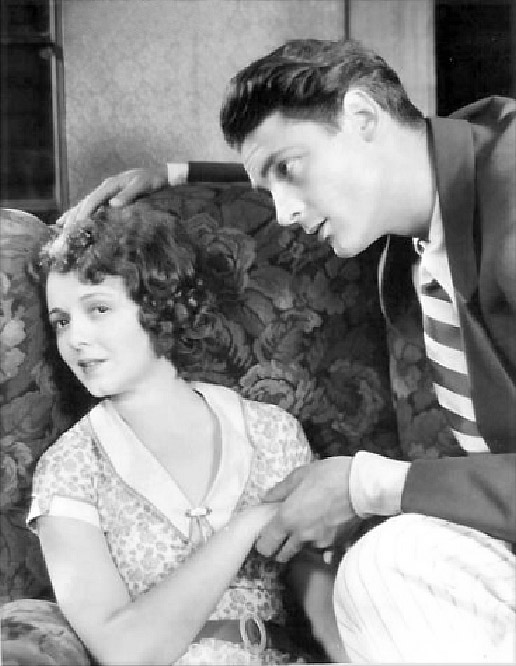
Janet Gaynor and Charles Farrell were teamed again in Sunny Side Up (1929), one of the first film musicals. Farrell and Miss Gaynor had starred -- successfully -- as a romantic couple in three silent films, so it must have seemed a "natural" pairing when Fox cast them in this, their first musical film. Gaynor plays Molly, a girl who lives happily in the New York tenements, and she gets things rolling with a charming rendition of the title song. Farrell is Jack Cromwell, a handsome Long Island millionaire who drives into Molly's neighborhood on a lark one evening, and is instantly smitten with her.
He doesn't know, of course, that secretly, Molly has worshipped him from afar after cutting his photo out of the newspaper. They meet cute -- he wanders into her apartment while she's still in her lingerie -- and after that, they get along famously, though she's in love and he thinks merely that Molly is "a swell girl."
All that changes, though, after Molly goes to Long Island at Jack's request -- properly chaperoned by her best galpal and two trusted male friends. As they get to know each other, Jack comes to realize he truly loves Molly; but now there's a barrier between them, for she thinks he is merely pitying her for being poor.
There are plenty of good songs, all written by the formidable team of DeSylva, Brown, and Henderson: In addition to the title song, we hear "I'm a Dreamer (Aren't we All)" sung by Miss Gaynor; "If I Had a Talking Picture of You," sung by both stars; and, in a big production number, "Turn on the Heat," sung and danced by dozens of girls who go from wearing parkas and heavy boots to stripping down to bathing suits, as the set warms up to tropical temps.
Sunny Side Up is probably the first film musical that isn't a "backstage" musical. All the songs and dances take place in what passes for real life.
Farrell and Miss Gaynor can't really sing, of course. But they could both carry a tune, and they were both charmers. And, as Samuel L. Jackson would say, several decades later, of an entirely different creature, "A little charm can go a long way."
Wednesday, November 15, 2006
KIKI (1931)

KIKI (1931)
Mary Pickford's Kiki (1931) is not generally considered one of her best films, but I found it thoroughly enjoyable. Probably this was an attempt by the legendary Ms. Pickford to "jazz up" her image. Long gone were the billowy curls of her early films, where she played young girls even after she was in her thirties. Here, she sports jazz-age bobbed hair, plays a flirtatious chorus girl, and is clearly a woman "on the make" -- though chastely -- for the character played by her costar, Reginald Denny. Quite a departure from Mary Pickford's "America's Sweetheart" persona.
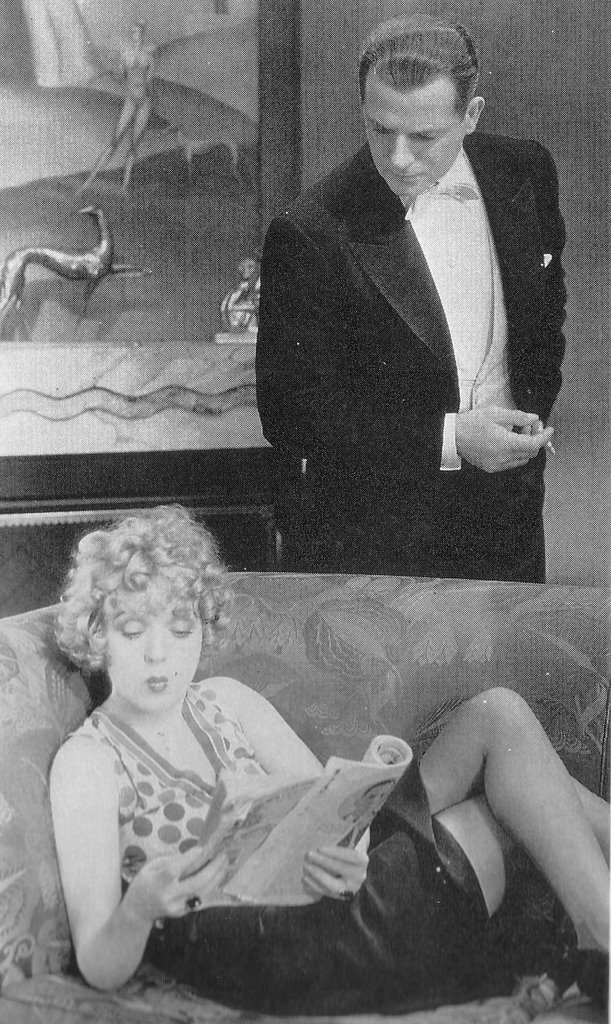
I've said that in Kiki, Ms. Pickford tries to "jazz up" her image. Here, she shows us her legs (which were "not bad" for someone only 5 feet tall); she removes her brassiere from beneath her blouse while standing in front of Denny; and in a later scene, she sits in front of his male assistant in her lingerie and unconcernedly puts on her stockings, slowly, one leg at a time.
The film is lively and kinetic, almost a slapstick comedy. Ms. Pickford delivers kicks to various backsides, among them Reginald Denny's and Margaret Livingston's, and gets kicked herself. Twice, Ms. Pickford is seen falling on her rear end. She even tumbles off the stage and into the orchestra pit, landing seat first into a drum -- a stunt her friend Charles Chaplin would use, years later, in Limelight (1952). I thought everyone in Kiki was extraordinarily game. They were all obviously hoping to make this film hilarious.
Unfortunately, Kiki flopped at the box office, and Ms. Pickford would make only one more film -- Secrets, another flop. The writing on the wall was now more legible than ever. Maybe the public felt that, at age 38, Ms. Pickford was reaching a little too hard for the youth serum. The era of "America's Sweetheart" was over.
But she left behind a legacy of great performances, and a great public enthusiasm for America's first major female movie star.
Tuesday, November 07, 2006
ROBERTA (1935)

ROBERTA (1935)
A film review by Dan Navarro
Copyright Dan Navarro 2006
"Roberta" was one of the major musical triumphs of the 1933 Broadway season. Set in a glamorous Paris between the two world wars, the play oozed romance, elegance, and continental sophistication... or at least enough of those qualities to divert attention from its absurd plot. A winning score by Jerome Kern lifted "Roberta" several stratospheres above its banal libretto; a good thing too, because without that boost, the show might never have been translated to the screen to become the perfect showcase for the talents of Fred Astaire and Ginger Rogers.
Reams have been written, and will continue to be written, about the superb dance partnership that was Astaire and Rogers. In their initial pairing as supporting players in Flying Down to Rio (1933), they captivated the public, and soon became the movies' favorite dancing couple. But a quirk of fate has, until recently, shrouded what is arguably their finest collaboration, in RKO's 1935 movie version of Roberta.
Because M-G-M bought the rights to the musical in order to create its own version, Lovely to Look At, in 1952, the RKO movie was kept off television and off video dealers' shelves until the 1990s. Whole generations of film fans have grown up loving Fred and Ginger in classics such as The Gay Divorcee (1934), Top Hat (1935), and Swing Time (1936) without ever savoring the one film -- Roberta -- that really established Astaire and Rogers as superstars. This is dancing at its endlessly watchable best.
The plot, such as it is, concerns American football player John Kent (Randolph Scott), who inherits his aunt Minnie's successful dress salon ("Gowns by Roberta") in Paris. There, he falls in love with the firm's head designer, Stephanie (Irene Dunne), who turns out to be an exiled Russian princess in disguise. Boy gets girl, boy loses girl, then girl storms back like the cavalry in the last reel to save the faltering business by staging a mammoth fashion show, complete with beautiful models, and lots of singing and dancing. Finis.
Fred Astaire plays Huck Haines, a struggling bandleader and the hero's best pal. Ginger Rogers is Huck's old childhood flame Lizzie Gatz, who is in Europe masquerading as a Polish countess, Tanka Scharwenka. Perhaps because they have little responsibility for carrying the burden of the plot, Astaire and Rogers seem positively liberated in their roles, and their dancing together seems more spontaneous than ever.
Lizzie, using her fake title as leverage to persuade a reluctant impresario (Luis Alberni), gets Huck's band a job at the Cafe Russe, where she sings as Countess Scharwenka. Then, during a rehearsal session with the band, Lizzie sings the Jerome Kern-Bernard Dougall ditty, "I'll Be Hard to Handle", complete with phony accent and much sly humor... and in so doing, she launches one of the great Astaire-Rogers dance duets. The song is sweet and hot, two choruses and it ends, and we think the number is over. But it isn't, yet. While the band vamps lightly, Huck and Lizzie begin a friendly conversation, reminiscing about the old days; then, in the most casual, spontaneous way, they begin dancing together. Lightly they sway, then so gradually that we don't realize it's happening, their dance becomes a major musical event.
Arlene Croce, author of a definitive volume on Astaire and Rogers, says of "I'll Be Hard to Handle": "This is the big event of the film, the number in which 'Fred and Ginger' became fixed screen deities." It certainly gets your attention. They start with a rhythmic shuffle, then after eight bars he gently takes her by the waist and together they spin around and around, settling at last into one of the most brilliant and inventive tap duets ever filmed. Halfway through the number, they separate and have a tap "conversation", each taking a phrase, then each responding with a salvo of taps. The band strikes up a bugle call, and Rogers snaps to military attention, only to be distracted by Astaire's invitation to resume their buoyant pas de deux. They continue the breathtaking duet as the music rises to a new wave of excitement; then, just as our hearts are ready to burst with exhilaration, they whirl one last time and collapse into two chairs.
As satisfying as the number is, "I'll Be Hard to Handle" seems to resonate with us out of all proportion to its value as a screen event, to move us in a way few movie dance numbers ever have. Now that we have video that can be played and replayed endlessly, at last we can put our finger on the number's special ingredient: The entire sequence -- three minutes of exquisite skill and grace -- is filmed as a single shot, with no breaks in the action, no skewing of camera angles, no interruptions in the flow of the dance. Knowing that Astaire was a perfectionist who sometimes demanded as many as eighty takes before pronouncing a dance number fit to be seen, we can appreciate how pleased he must have been with this particular take, to let it occupy three minutes of uninterrupted screen time, with no cuts. And he was right: This performance is perfection itself. There would be other great dance duets by Astaire and Rogers, and by other dancers; but prophetic title and all, "I'll Be Hard to Handle" would be tough to top.
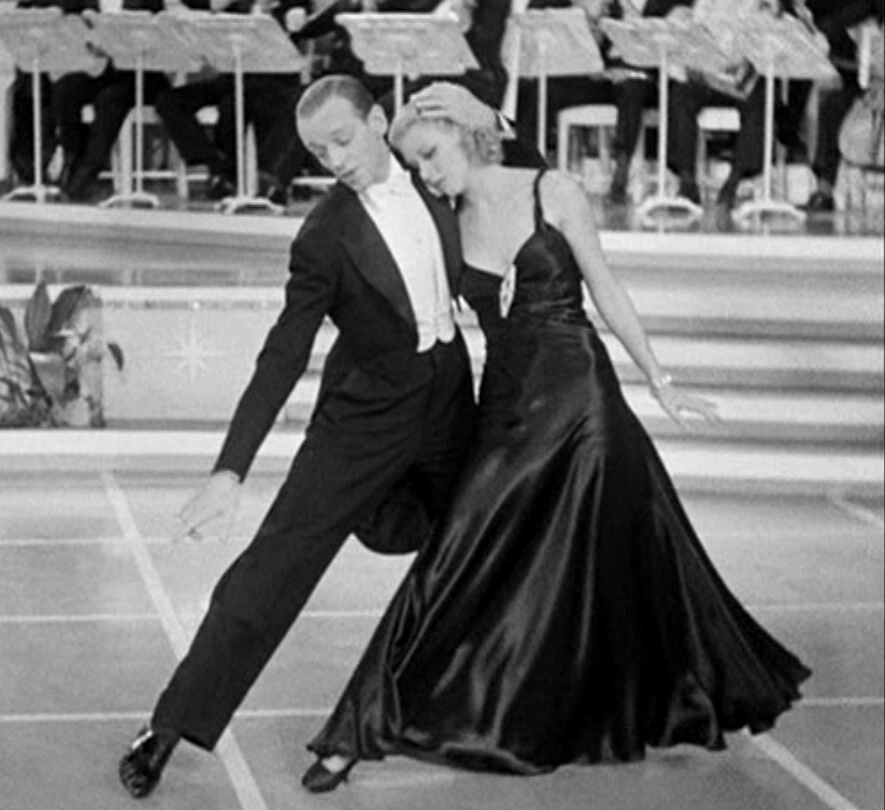
"Smoke Gets in Your Eyes" is probably the most famous of the Roberta songs. In the film it is sung by Irene Dunne as Princess Stephanie, and is later reprised as a romantic adagio by Astaire and Rogers. Astaire once told this reviewer that he didn't like to do love scenes -- and, sure enough, there are very few conventional love scenes in the Fred Astaire oeuvre; he always preferred to express his feelings for his partners through their dances. His choreography for "Smoke Gets in Your Eyes" is like a love scene, treating Rogers both like a queen and like a delicate rose. There is a moment where they walk side by side, he pressing her head lightly against his shoulder. The dance casts a powerful spell, but it is kept short, and it ends with us wanting more.
The climactic fashion show, showcasing the new gowns by Roberta's dress salon draped on several gorgeous models (Lucille Ball among them), is played out to "Lovely to Look At", a romantic ballad written by Kern for the film. Irene Dunne sings while the models parade their stylish frocks, and soon afterwards the temporary conflict between Stephanie and John Kent is resolved. The lovers embrace, romance is in the air, and it seems to be contagious; even Huck and Lizzie make tentative plans to marry.
RKO, which was gleefully raking in the gate receipts from the previous Astaire-Rogers film, The Gay Divorcee, while Roberta was in production, wisely chose to close Roberta with a shot of Astaire and Rogers, the new superstars, rather than the top-billed Irene Dunne. The die was cast. Cite Flying Down to Rio as the first film to pair this extraordinary duo. Credit The Gay Divorcee for being their first starring vehicle. But salute Roberta as the film that finally distilled the essence of Astaire and Rogers, and sent their lucky star spinning into permanent orbit.
Thursday, November 02, 2006
DESTRY (1954)

DESTRY (1954)
A film review by Dan Navarro
Copyright 1996 Dan Navarro
Destry Rides Again (Universal, 1939) is usually accorded near-mythic status in books and film commentaries. It teamed James Stewart, a hot new star fresh from his triumphant Mr. Smith Goes to Washington, with the glamorous Marlene Dietrich in the story of a gun-hating deputy sheriff who succeeds in cleaning up a lawless town. The film was so well-received, its title is nearly always mentioned in lists of the great films of that banner year, 1939.
But Destry Rides Again is not the last word. The film was remade as Destry fifteen years later by the same director, George Marshall, this time in Technicolor, with Audie Murphy in the central role of the gun-shy deputy. The slick patina of the Stewart-Dietrich version, combined with the celebrated legend naming 1939 as Hollywood's Greatest Year, have worked to downgrade the 1954 Destry in the public's mind as an inferior remake. It is nothing of the sort. Destry is a near-classic Western, complete and satisfying in every way, and it boasts performances that in some ways eclipse the efforts of the 1939 cast.
In the old West, a small frontier town named Restful is anything but. Hooligans roam the streets freely, random gunplay erupts everywhere, and peaceful citizens live in fear for their lives. The town has an overworked sheriff, but the real power in Restful resides with Phil Decker (Lyle Bettger), a corrupt saloon owner who is the equivalent of a big-city crime boss. Decker and his cronies operate in league with the slimy local mayor (Edgar Buchanan, magnificent in a rare villainous role) and Decker's own dance hall girl, Brandy (Mari Blanchard, so luminous she almost gives corruption a good name).
When the sheriff tries to interfere in one of Decker's crooked schemes, Decker has the lawman casually gunned down. Then, to insulate himself from further interference, Decker arranges to have the town drunk, Rags Barnaby (Thomas Mitchell), named the new sheriff, thinking he will be ineffectual. But Rags surprises everyone by taking his new appointment seriously. He goes on the wagon, then sends for Tom Destry, the son of a former two-fisted lawman, to be his deputy.
Tom Destry (Audie Murphy) arrives in Restful, looking nothing like the swaggering he-man the sheriff had in mind. In fact, Destry doesn't even carry a gun. The new arrival is soft-spoken, polite and deferential, the antithesis of the intrepid Western hero of legend. And Destry does let himself get pushed around -- by Decker, by his gunsels, even by the femme fatale, Brandy. But director Marshall is just setting us up, and we know it. We watch in silent glee, waiting for the inevitable moment when the worm will turn, and the meek will inherit the earth. When Destry's controlled rage surfaces at long last, he smites the villains mightily, with a vengeance that out-Shanes Shane.
Marshall's chief asset in this retelling of the Destry story is, of course, Audie Murphy. In World War II, Murphy had won the Congressional Medal of Honor for valor in combat, as well as 23 other decorations; and yet, this heroic fighting tiger turned out to be diminutive and baby-faced. Standing no more than five feet eight, with the angelic face of a well-scrubbed choir boy, Murphy must have seemed a "natural" for the role of the reluctant gunfighter Tom Destry. As it turned out, not only was his physical appearance ideal for the role; his acting style, always low-key, fit the Destry mold perfectly.
James Stewart was, of course, one of the finest actors ever to appear in American cinema, and he was eminently qualified for most of the roles he played. But at well over 6 feet tall, he towered over his fellow cast members in Destry Rides Again, and was by nature unable to project the vulnerability his role demanded. (Perversely, the casting department gave the role of Destry's chief nemesis to the shorter-than-average Brian Donlevy.) Stewart also had a habit of punctuating his most intense dramatic moments with the dark, wild-eyed visage of a deranged man. We can see that look in It's a Wonderful Life (1946), when Stewart's George Bailey is confronted with a nightmarish vision of the world, and in that sequence his expression was most appropriate. But he uses the "crazy George Bailey look" four times in Destry Rides Again, and it's unsettling, because we never expect to see the easy-going, nonviolent Tom Destry look that unstable.
Audie Murphy's Destry is, by contrast, calm and friendly even in his most trying moments, as when he is forced to break up some recreational gunplay by local toughs. Instead of glaring daggers at them, he smiles and graciously asks the men to let him borrow their guns. Amused, they decide to humor the pint-sized pacifist by handing him their guns, because up until now they have had no reason to fear him. All that changes, as Destry rapidly empties the pistols by picking off twelve tiny furniture knobs from a distance, in a dazzling display of marksmanship. In that instant, the lamb shows his fangs. It's a defining moment in the film. Even if you knew it was coming because you saw the 1939 version, it still catches you by surprise because this time around, Destry has seemed like such a powerless little pussycat.
Mari Blanchard sparkles as Brandy, the amoral saloon queen. She plays Brandy with a sexy exuberance, perhaps mindful that she was enjoying the best role of her career, after a string of small parts in B-pictures.
Brandy is an intriguing puzzle: A bad girl who cheerfully aids and abets her lover, Decker, as he runs crooked poker games and fraudulent land schemes -- but who is nevertheless attracted to the peace-loving Destry and his basic decency. Blanchard also gets to sing and dance to three numbers composed for the film by Frederick Herbert and Arnold Hughes, although an upbeat tempo can't disguise the fact that one of the songs, "Bang! Bang!", is basically the same tune as "See What the Boys in the Back Room Will Have", sans Dietrich's husky vibrato.
Destry's dramatic stability is provided by the redoubtable Thomas Mitchell, as the town drunk turned sheriff. The veteran screen actor had won an Oscar (for Stagecoach, 1939) and two nominations, and was clearly the class of the Destry cast. There is hardly a moment in any of his scenes when he does not own the camera. Every inflection in Mitchell's voice, every nuance of expression, is done with authority. Watch him in the scene where Rags Barnaby is informed, upon being awakened from a drunken stupor, that he has been named the new sheriff. He steadies his bloodshot eyes, firms his jaw, flings away the bottle he was holding, and declares, in the voice of a man who's trying desperately not to sound inebriated, "A man's got to choose between th' bottle and th' badge!" And with head held high, he marches away on wobbly legs that haven't quite sobered up yet. It's a moment of bravura acting by an old pro who understood what screen presence was all about.
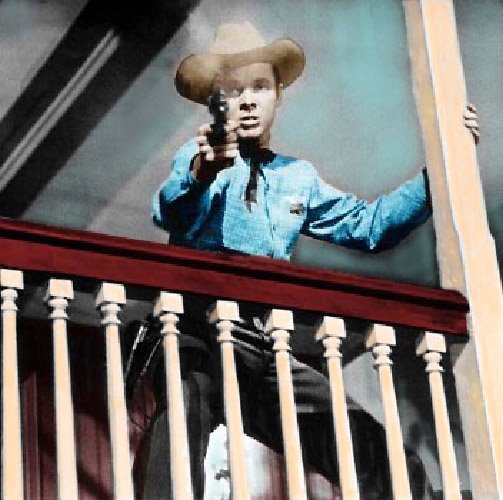
But the enduring image in Destry is of Audie Murphy as the quietly courageous man of peace who, in the end, is forced to take up arms against the forces of evil. The moment when Destry finally, reluctantly, straps on his gunbelt and heads out the door to take care of business is one of the great scenes in Western films. It is beautiful, as justice is beautiful. And we have been so carefully set up for this moment that we are no longer sophisticated observers; we are little children, cheering in the knowledge that soon, all the ugliness will be wiped out, and the world will be a happy place again.
Thursday, October 26, 2006
THE OFFICE WIFE (1930)

A film review by Dan Navarro
Copyright Dan Navarro 2006
The Office Wife (1930) puts the beautiful silent screen actress Dorothy Mackaill into sound pictures and introduces Joan Blondell to the screen. For those laudable achievements alone, this film deserves kudos.
But it really earns its welcome by presenting a charming story about wealthy businessman Larry Fellowes (Lewis Stone) who, though married, finds himself falling for his private secretary, Anne Murdock -- the "office wife" of the title -- in the person of Ms. Mackaill.
Anne likes him too, and we are treated to an exquisite tension between them, as they go about the firm's business, each of them falling more and more in love with the other, yet having to remain very businesslike in their relationship.
Finally Larry gets up the nerve to give Anne a kiss... but before you holler "employee harassment!", take a good look at Anne's posture just before the kiss. She is totally asking for it. She puts her face close to his, and her body language practically DARES him to kiss her. He does. What to do now? Joan Blondell, as Anne's sister, learns that Fellowes' wife is planning to divorce him -- for reasons unconnected to Anne -- so Joan gives her sister's boss a phone call, letting him know that Anne has "fallen for her boss," without explicitly naming him. Our gal Joan knows how to set up a situation.
I didn't signal "spoilers" at the start of this commentary, because I think that's unnecessary. We know from Anne and Larry's first meeting that these two are going to wind up together. One may say that Lewis Stone is "too old" for Dorothy Mackaill, and in truth he was her senior by 24 years. But they are very "simpatico" together, and are a winning couple. Sort of like Michael Douglas and Catherine Zeta-Jones in the modern day.
Dale Fuller, who played tragic females in Souls for Sale (1923) and Greed (1924), plays another one here, as a secretary who secretly yearns for Larry's love. Maybe Ms. Fuller was typecast, but she certainly did play that sort of role well.
In this precode, we get to see Joan Blondell put on her stockings, slowly, one leg at a time... a scenario that she would duplicate in several other films of the era. The act became so familiar that, in Foothill Parade (1933), she threw the folks a switcheroo, putting both stockings on the same leg. "Accidentally," of course.
The Office Wife clocks in at just under one hour in length, making it one of the shortest and most enjoyable precodes ever.